
 Safe Patient Handling
  Gold Rollboards
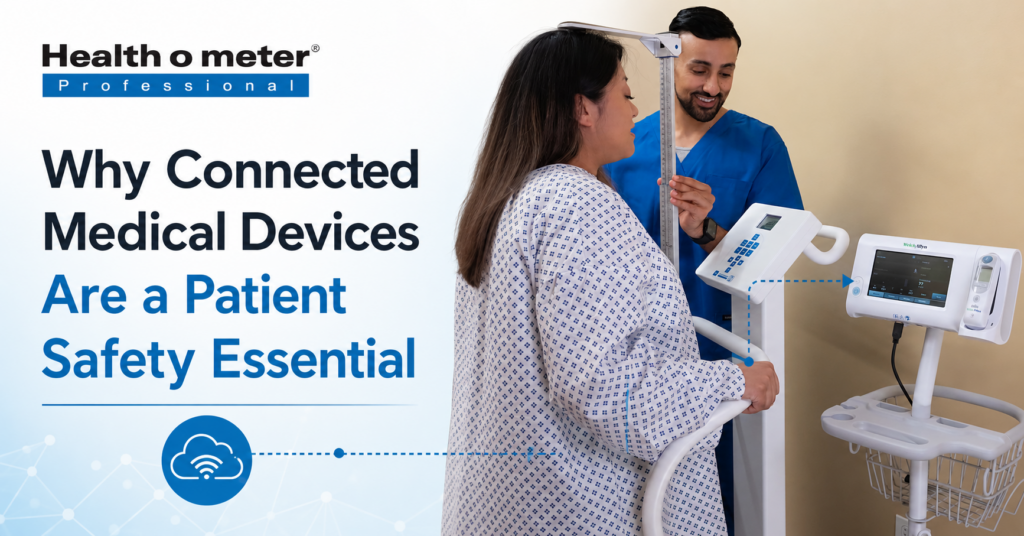
When healthcare facilities evaluate new medical device purchases, one of the first questions buyers should ask is: Does this product have connectivity?
Connectivity means a device can electronically transmit data to another system — such as a vital signs monitor, a PC, or an electronic medical record (EMR) platform. This connection may be established through integration partnerships between device manufacturers, Bluetooth® pairing, or other communication protocols. The result: patient measurements captured at the point of care are sent directly into the patient's record — no pen, no paper, no manual re-entry required.
The Problem with Manual Data Entry
In a busy clinical environment, even small transcription errors can have serious consequences. A misplaced decimal point in a weight measurement, or a transposed digit, can lead to incorrect medication dosing — a patient safety risk that connectivity helps eliminate entirely.
When a caregiver manually records a measurement and later types it into a system, there are multiple opportunities for human error. Connected devices close that loop. Data flows automatically from the device to the patient record, reducing the chance of mistakes and freeing caregivers to focus on what matters most: the patient.
Key Benefits of Connected Medical Devices
- Improved accuracy. Direct data transmission eliminates transcription errors, ensuring measurements like weight, height, and BMI are recorded exactly as captured.
- Enhanced patient safety. In areas where medication dosage is weight-based, an accurate and reliable weight measurement is critical. Connectivity supports safe, precise dosing by ensuring that data is correct from the moment it is captured.
- Greater efficiency. Automatic data entry saves clinicians valuable time during every patient encounter. Seconds add up — across a full shift, connected workflows can meaningfully reduce documentation burden.
- Standardized records. A connected scale configured to transmit in kilograms only, for example, ensures every weight entry in the system uses the same unit — supporting both data consistency and weight-based dosing safety protocols.
Choosing the Right Connectivity Solution
Not all connectivity solutions are the same, and the right fit depends on a facility's existing infrastructure, workflow, and EMR system. When evaluating options, consider:
- Integration compatibility — Does the device connect with your existing vital signs monitors or EMR platform?
- Data flow — Is transmission automatic, or does it require manual initiation by the caregiver?
- Unit standardization — Can the device be configured to transmit in a single unit of measure?
- Vendor support — Does the supplier offer multiple connectivity pathways to accommodate different system environments?
Choosing a supplier that offers flexible, scalable connectivity options helps ensure a smooth integration into your facility's workflow — both now and as your technology environment evolves.
Health o meter® Professional Scales Connectivity Solutions
Health o meter® Professional Scales offers a range of connectivity solutions designed for healthcare environments, enabling seamless transmission of weight, height, and BMI measurements to vital signs monitors, PCs, and EMR systems. These solutions are built to enhance workflow efficiency, support patient safety, and simplify the documentation process for clinical staff.
To explore the full range of connectivity options, visit: homscales.com/connectivitysolutions