
 Safe Patient Handling
  Gold Rollboards
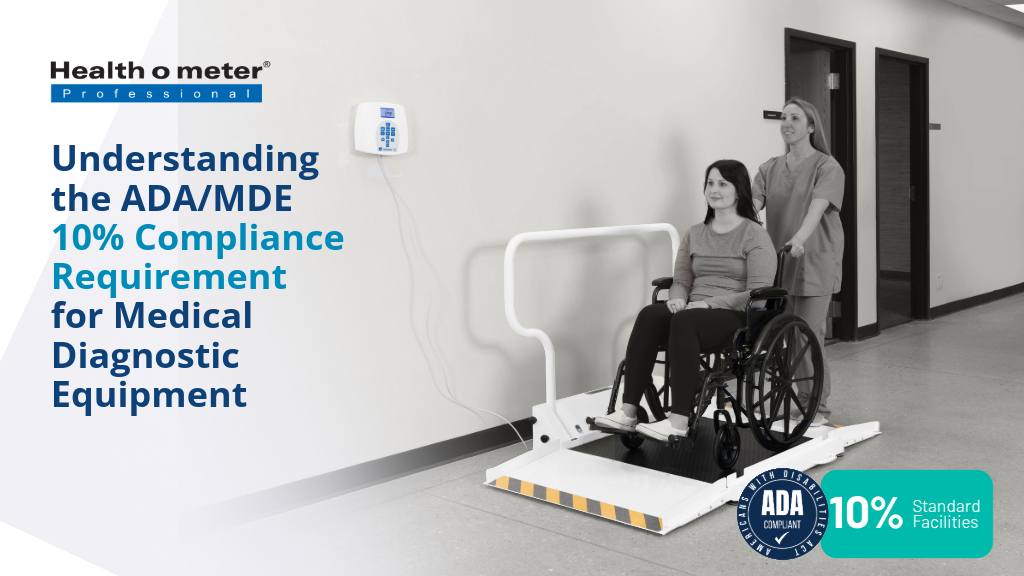
Healthcare providers across the country are working to meet new federal accessibility requirements for medical diagnostic equipment (MDE). At the center of these requirements is a "10% threshold," a scoping rule that determines how much equipment must be accessible to patients with disabilities. But where did this number come from, who decided it, and what does it actually mean for healthcare organizations?
What is the 10% Requirement for MDE?
The 10% threshold is the scoping rule for medical facilities: for each type of equipment they use, at least 10% of the total units, but no fewer than one unit, must meet the Standards for Accessible MDE. For rehabilitation facilities, the scoping requirement is 20%.

This percentage serves as a practical middle ground. Rather than requiring every unit of medical equipment to meet accessibility standards regulators established a balanced approach: ensure patients with disabilities have reliable access without requiring full equipment replacement.
Who Established the 10% Scoping Requirement?
In response to the U.S. Access Board’s new standards for medical diagnostic equipment (MDE), Health and Human Services and the Department of Justice established the scoping requirements. HHS (under Section 504 of the Rehabilitation Act, 45 CFR § 84.92) for providers receiving federal funding, and the Department of Justice (under ADA Title II, 28 CFR Part 35) for state/local government facilities.
As stated in HHS (Section 504, 45 CFR Part 84), “At least 10% of the total number of units of each type of equipment (but no fewer than one unit) must meet the Standards for Accessible MDE, per 45 CFR § 84.92(b). Facilities specializing in conditions that affect mobility (e.g., rehab or physical therapy centers) must hit 20% instead.”
The Access Board only wrote the technical standards (what makes a unit accessible). The MDE Standards themselves do not specify the minimum number of types of accessible medical equipment required in different types of health care facilities.
How was 10% Determined as the Requirement?
Regulators based the 10% threshold on an older rule about patient rooms. The 2010 ADA standard for patient rooms said “Facilities that don't specialize in treating mobility-related conditions must make at least 10% of their patient sleeping rooms accessible, with a minimum of one room.” Regulators then adapted that percentage framework when establishing the 10% rule for MDE.
What Does the 10% Requirement Mean in Practical Terms?
The rule does not require replacing every piece of medical diagnostic equipment. It sets a minimum threshold – a defined percentage of each type of equipment that must be accessible, with a minimum of at least one unit. The rules state that facilities must have at least 10% of their equipment, but no fewer than one unit, meeting the standards. This 10% refers to each category type such as, Equipment Used by Patients Seated in a Wheelchair and Equipment Used by Patients in Standing Position that are referenced in Chapter 3 of the standards. For example, 10 % of a facility’s stand-on scales and 10% of their wheelchair scales must meet the new MDE technical standards.
Example: How the Rule Applies to Weight Scales:
- If a facility has 8 stand-on scales, at least 1 must meet the new standards
- If the facility does not have a wheelchair scale, they must add at least 1 to ensure patients can be weighed while seated in their wheelchair
- A dual-purpose scale that meets both stand-on and wheelchair requirements can count toward both categories
At its core, the point of the percentage threshold is to guarantee real access without requiring every single piece of equipment to be accessible. Since patients only use a scale for a few minutes at a time, and lots of different patients share the same equipment throughout the day, regulators decided not every unit needs to be accessible — just enough of them, so a patient with a disability always has one available when they need it.
Complying with the 10% requirement doesn't have to be complicated. Health o meter® Professional offers several options for accessible weight scales designed to help facilities meet the new standards. Whether you're adding your first accessible scale or building out toward the full 10% (or 20%) requirement, the right equipment can make compliance simple, so your facility can focus on what matters most: giving every patient equal, dignified care.
Schedule your complimentary ADA consultation today or explore /ada-mde for ADA compliant stand-on and wheelchair scales options from Health o meter® Professional.