
 Safe Patient Handling
 Gold Rollboards

A scale that won’t settle on a reading, a wobbly handlebar, a torn platform mat — small problems like these slow down busy departments and can put patient safety at risk. Because so many clinical decisions depend on an accurate weight, medical scales deserve a regular, structured check-up just like any other piece of critical equipment.
Routine equipment assessments help facilities spot safety hazards early, decide which devices need repair or replacement, and keep workflows running smoothly. Here’s what a thorough medical scale assessment should cover, along with a free, printable checklist your team can take onto the floor.
1. Start with the people who use the scales every day
Clinicians and staff are often the first to notice when something isn’t right. Ask whether they’re running into recurring problems, either mechanical or in day-to-day use. For medical scales in particular, ask:
- Does the scale have trouble locking onto a patient’s weight, or onto an infant’s weight on a pediatric scale?
- Is it difficult to raise or lower the platform?
- Is the scale hard to move from one area of the facility to another?
Their answers will point you to the equipment that needs a closer look.
2. Inspect for damage and wear and tear
Next, physically examine each scale for broken parts and signs of age. What to look for depends on the type of scale:
- Stand-on platform scales: Make sure the handlebars aren’t loose and the platform mat isn’t torn or peeling. The main column should be secure and stable, and if the scale includes a height rod, it should be firmly attached. Check that the pan around the platform isn’t filled with dirt and debris, and that the bottom tray isn’t bent or causing the scale to wobble.
- Pediatric tray scales: Check that the tray isn’t chipped or dirty, the mounting pegs aren’t broken, and the handles aren’t loose.
- All scales: Look over the overall appearance, paying special attention to rust or built-up dirt.
3. Look for infection prevention risks
A scale can be in perfect working order and still create problems. Some designs have gaps or crevices where dirt and bacteria can collect, making them harder to clean and working against your hospital’s infection prevention efforts. Flag any scale with hard-to-clean contamination points.
4. Confirm the equipment still fits the department’s needs
Finally, consider whether each scale is still the right tool for the job. For example, wheelchair scales should have enough room to accommodate every wheelchair size your department sees, with ramps at a slope patients and staff can manage comfortably. If a scale no longer meets the needs of the people using it, it may be time for an upgrade.
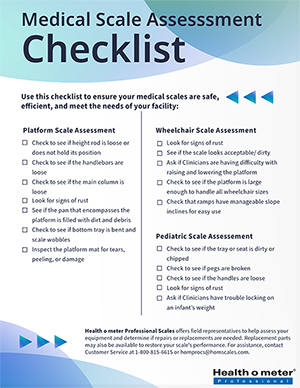
Download the Medical Scale Assessment Checklist
Put these steps into practice with our free checklist. It covers platform, wheelchair and pediatric scales in a single page, so your team can print it and work through each scale in your facility.
Get expert help with your assessment
You don’t have to do it alone. Equipment manufacturers such as Health o meter® Professional Scales often have field representatives who can help your facility evaluate its existing equipment and determine whether a new scale is needed. In many cases, replacement parts can return a scale to optimal condition without a full replacement.
Have questions about your scales? Contact Health o meter Professional Customer Service at 1-800-815-6615 or homprocs@homscales.com.