
 Safe Patient Handling
  Gold Rollboards
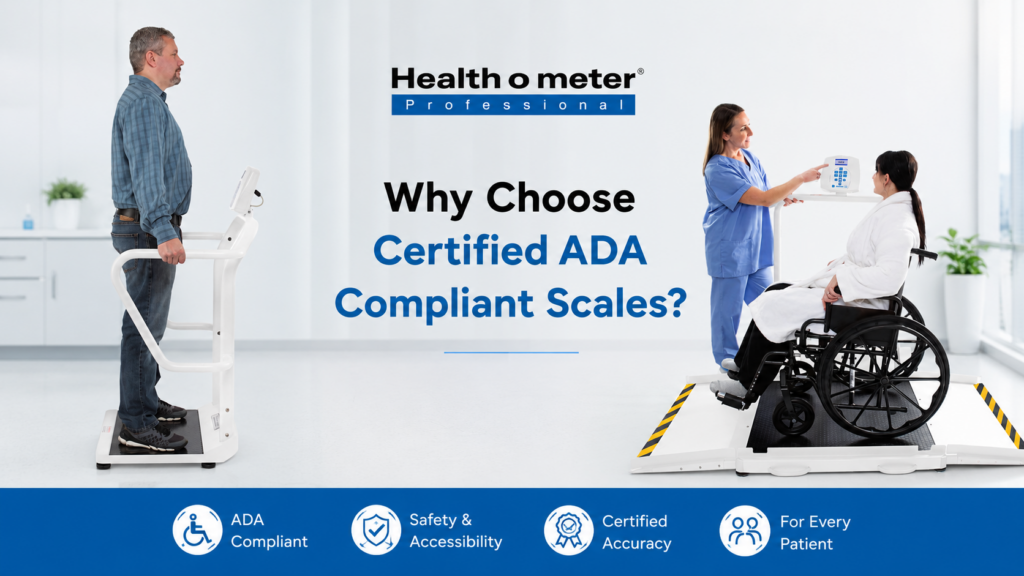
Accessibility isn't optional. It's essential — and it's now the law.
For healthcare providers, ensuring every patient receives equal access to care isn't just the right thing to do, it's a federal obligation. With new Medical Diagnostic Equipment (MDE) accessibility standards now in effect, the question is no longer whether your facility needs to comply, but how quickly you can get there.
Weight scales are one of the most frequently used pieces of diagnostic equipment in any clinical setting. Yet for patients with mobility disabilities, a non-compliant scale can mean receiving an inferior standard of care or no measurement at all. That's an ADA violation, a clinical risk, and a liability exposure all in one.
What Are the New MDE/ADA Compliance Requirements?
In July 2024, the U.S. Access Board published updated standards for medical diagnostic equipment. These rules define specific technical requirements for equipment used in healthcare settings — including wheelchair scales, stand-on scales, exam tables, imaging equipment, and more.
The compliance deadlines are imminent:
- July 8, 2026: Private providers receiving HHS funding (e.g., Medicare/Medicaid)
- August 9, 2026: State & local government entities (Title II), including public hospitals and community clinics
These standards are enforceable. HHS (through the Office of Civil Rights) oversees compliance for federally funded facilities. The DOJ enforces compliance for government and private facilities alike.
What Does "Certified" ADA-Compliant Actually Mean?
Here's an important distinction: neither the U.S. Access Board nor HHS certifies or approves individual products. A manufacturer can claim their equipment is ADA-compliant, but without independent third-party verification, that claim is unverified.
Third-party certification, such as the ADA product certification offered by Corada — means that an independent expert has rigorously reviewed the product and confirmed it meets the technical standards. This matters because:
- Manufacturers are not neutral parties when assessing their own compliance
- Technical standards are detailed and nuanced — small deviations can mean non-compliance
- Independent certification provides documentation you can present in an audit, OCR review, or legal proceeding
4 Reasons to Choose Certified ADA-Compliant Scales
1. Independent Verification You Can Trust
Each certified scale has undergone rigorous third-party review confirming it meets ADA requirements — from platform width and ramp slope, to edge guards and handrail height. You're not relying on a manufacturer's self-assessment. You have documentation.
2. Legal Protection for Your Facility
Non-compliance carries real consequences: civil monetary penalties, corrective action mandates, suspension of Medicare/Medicaid funding, settlement agreements, and federal lawsuits. A certified compliant scale is a documented layer of protection. When a disabled patient cannot be weighed, it constitutes a materially different standard of care — and that's grounds for an ADA discrimination claim under Title III, regardless of whether your practice is public or private.
3. Regulatory Confidence Across the Board
Whether your facility is subject to DOJ enforcement under ADA Title II or Title III, or to HHS enforcement under Section 504 of the Rehabilitation Act, certified equipment demonstrates good-faith compliance. OCR investigations are a matter of public record — and patient advocacy organizations actively monitor outcomes. Certified scales help you stay ahead of scrutiny.
4. Better Care for Every Patient
Medication dosing, anesthesia planning, and chronic disease management all depend on accurate weight measurements. When patients cannot be properly weighed, clinicians substitute estimates — and that substitution carries real clinical risk. Certified accessible scales eliminate that gap, ensuring patients with mobility disabilities receive the same standard of care as every other patient.
What to Look for in a Compliant Scale
Wheelchair Scale Requirements:
- Platform width: minimum 36" (32" for platforms under 4" tall)
- Platform depth: 40" (pass-through), 48" (front/rear entry), or 60" (side entry)
- 2" edge protection on platform and ramps
- 1:8 ramp running slope
- Slip-resistant platform surface
- Minimum 800 lb weight capacity recommended
Stand-On Scale Requirements:
- Slip-resistant platform
- Handrail supports on both sides of platform
- Handrail height: 34"–38" from platform
Important: A compliant exam table with a built-in scale does NOT satisfy the wheelchair scale requirement. The Access Board has explicitly stated that an integrated table/scale system does not meet the wheelchair scale provisions. Facilities must have a dedicated method to weigh patients while they remain seated in their wheelchair.
How Many Compliant Scales Does Your Facility Need?
The rules don't require replacing every scale — but they do set a minimum threshold:
- Standard facilities: at least 10% of each equipment type must be compliant (minimum 1 unit)
- Mobility rehab facilities: at least 20% of each equipment type
The threshold applies separately to each equipment type. A practice with 5 wheelchair scales needs 1 compliant wheelchair scale; a practice with 12 stand-on scales needs 2 compliant stand-on scales. Note: facilities with fewer than 15 employees are not exempt — the small business exemption applies only to equipment purchased for employees, not for patients.
Are There Tax Benefits for Purchasing Compliant Equipment?
Potentially yes — facilities should consult their legal and accounting teams, but two tax provisions may apply:
- Section 179 Tax Credit: Allows businesses to deduct the full purchase price of qualifying equipment acquired or financed during the tax year.
- ADA Tax Credit (Section 44): Small businesses with fewer than 30 employees or less than $1M in revenue may qualify for a 50% tax credit up to $5,000 annually on accessibility improvement expenses.
Additional grant funding may be available through HRSA, the Small Rural Hospital Improvement Program (SHIP), and the Capital Assistance for Disaster Response and Recovery Efforts (CADRE) program.
The Bottom Line
Choosing a certified ADA-compliant scale isn't just a compliance checkbox — it's a commitment to delivering equal care to every patient who walks, rolls, or is wheeled through your door. It protects your facility from legal and financial risk. And it ensures the clinicians in your care have the accurate data they need to make sound clinical decisions.
With compliance deadlines weeks away, now is the time to act.
Explore certified ADA-compliant scales from Health o meter Professional: www.homscales.com/ada-mde
This blog post is provided for general informational purposes only and should not be construed as legal or regulatory advice. Healthcare organizations should consult qualified legal counsel and compliance teams to assess their specific obligations.