
 Safe Patient Handling
  Gold Rollboards
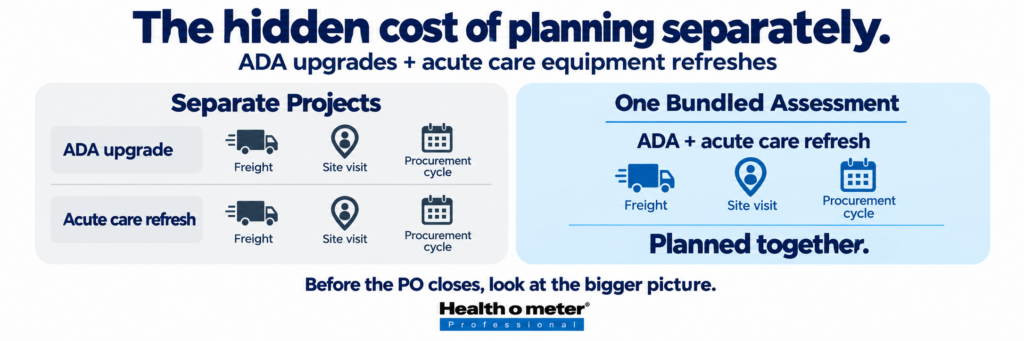
The Hidden Cost of Waiting: Why Facilities Are Bundling ADA Upgrades with Acute Care Equipment Refreshes
Across the country, healthcare facilities are moving through the same process right now: identifying which scales need to be replaced or upgraded to meet the new ADA/MDE accessibility standards, securing budget approval, and scheduling vendor site visits to install the new equipment.
It's a lot of coordination, capital planning, purchasing approvals, freight logistics, and a technician or field rep walking the floor. And for many facilities, once that process wraps up, it's treated as done. The compliance box is checked, the PO is closed, and everyone moves on to the next project.
But that approach leaves value on the table. The same procurement cycle, the same freight shipment, and the same site visit that get a facility to ADA compliance can just as easily carry a broader equipment refresh, if facilities plan for it up front.
Why "Waiting" Has a Real Cost
It's tempting to treat ADA compliance and acute care equipment planning as two separate projects on two separate timelines. In practice, treating them separately usually means paying for the same overhead twice.
Capital cycles don't come around often. Most facilities only get one or two windows a year to submit capital equipment requests. If an acute care scale replacement isn't part of this cycle's ADA request, it often means waiting for the next budget cycle, sometimes a full year away, even if the equipment is already past its service life.
Freight and installation costs are largely fixed, regardless of order size. Shipping one pallet of wheelchair scales costs nearly the same in coordination and scheduling as shipping a pallet that also includes a platform scale, a neonatal tray scale, or a patient transfer scale. Splitting these into separate shipments and separate vendor visits multiplies overhead without multiplying value.
A field rep is already walking your floors. When a manufacturer's representative visits to install or train staff on new ADA compliant scales, that visit is also the ideal moment to assess the condition of acute care equipment nearby: platform scales in the ED, neonatal scales in the NICU, transfer scales in the ICU or stroke unit. Scheduling a second visit later to do the same assessment is a missed opportunity.
Deferred replacements keep costing money quietly. Aging scales don't fail all at once. They drift out of calibration, require more frequent service calls, and slowly become a liability for both accuracy and safety. Every cycle a replacement is delayed, a facility absorbs those costs without a line item to show for it.
What Bundling Looks Like in Practice
Bundling doesn't mean facilities need to overhaul every department at once. It means using the ADA compliance project as the occasion to ask a broader question: while we're already replacing equipment, what else in our fleet is due?
For most facilities, that review touches a short list of high use, high visibility equipment:
- Platform scales in the ED or general medical floors that see heavy daily use and are approaching end of service life
- Neonatal and pediatric tray scales in Labor & Delivery or the NICU, where resolution and accuracy directly affect clinical decisions
- Patient transfer scales for stroke units, the ED, or ICU, where every minute in a time sensitive workflow matters
- Diaper/lap sponge/organ scales that may be years overdue for replacement simply because no one flagged them during the last purchasing cycle
None of these require a separate capital request, a separate freight shipment, or a separate site visit if they're identified during the ADA planning process. They just require asking the question early enough to act on it.
How a Single Facility Assessment Solves This
This is exactly what a full facility equipment assessment is designed to catch. Rather than evaluating ADA compliance in isolation, a comprehensive assessment looks at the full scale fleet, department by department, to flag:
- Which scales are approaching end of life or increasing in service calls
- Where accuracy or resolution no longer matches clinical needs
- Which departments are underserved by current equipment
- Where ADA compliance gaps and acute care replacement needs overlap
Health o meter® Professional and its network of more than 100 field representatives already build this kind of assessment into ADA compliance conversations. Because the Acute Care and ADA compliant product lines come from the same manufacturer, facilities don't need a second vendor relationship, a second training process, or a second set of spare parts to act on what the assessment finds: the products, support team, and purchasing process are already the same.
One Conversation, One Shipment, One Visit
The facilities getting the most out of their ADA compliance investment aren't treating it as a standalone project. They're using it as a checkpoint: a natural, already budgeted moment to look at the rest of their scale fleet and ask what else is due.
If your facility already has an ADA upgrade planned or in progress, it's worth a conversation before that PO closes. A quick assessment now could mean addressing acute care equipment needs in the same shipment and the same site visit, instead of waiting for next year's budget cycle to do it separately.
Ready to see what a combined assessment could look like for your facility? Visit www.homscales.com or call 1.800.815.6615 to connect with a representative today.