
 Safe Patient Handling
  Gold Rollboards
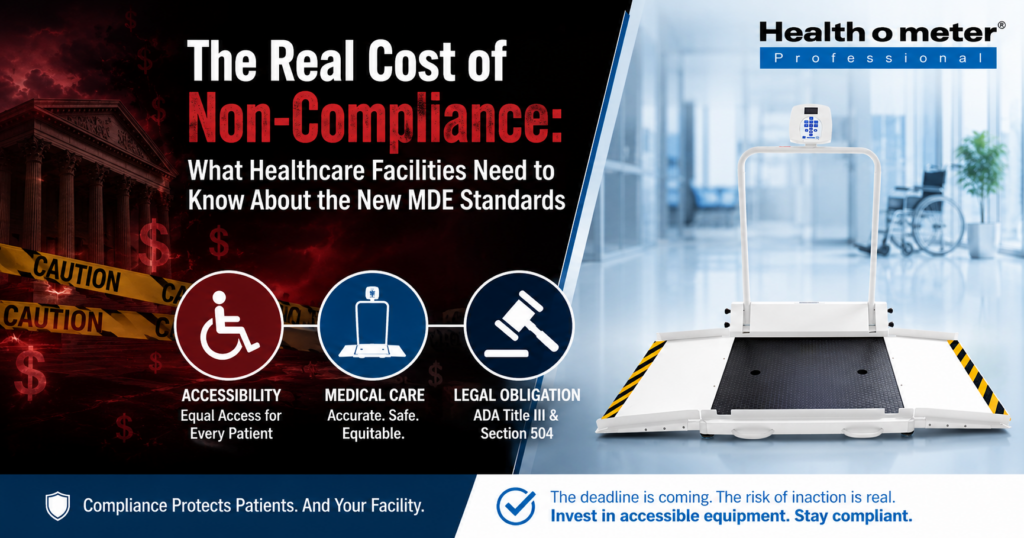
In July 2024, the U.S. Access Board published technical standards for medical diagnostic equipment (MDE) to ensure patients with disabilities receive equal access to care. For healthcare facilities, these standards aren't just suggestions, there are financial and legal risks for those that choose not to comply.
What Are the MDE Accessibility Standards?
The MDE Accessibility Standards are technical requirements issued by the U.S. Access Board that govern how medical equipment must be designed and used to accommodate patients with disabilities. The standards cover a wide range of equipment, including:
- Exam tables and chairs
- Weight scales
- Imaging equipment (such as MRI and X-ray machines)
- Other diagnostic tools used in routine patient care
The goal is straightforward: no patient should be denied an accurate examination simply because the equipment in a facility is inaccessible to them.
When Do Facilities Need to Comply?
Compliance deadlines are fast approaching:
- July 8, 2026 - for entities funded by the Department of Health and Human Services (HHS)
- August 9, 2026 - for state and local government facilities
By these dates, facilities must have at least 10% of their relevant equipment meeting the new standards, with a minimum of one unit. Mobility rehabilitation facilities face a higher threshold of 20%.
A Real-World Example: The Wheelchair Patient Who Can't Be Weighed
Consider this scenario: a patient who uses a wheelchair arrives for a routine exam. The facility only has a stand-on handrail scale. The patient cannot stand safely, and there is no accessible alternative available.
Under ADA Title III (which covers public accommodations) and Section 504 (which applies to federally funded providers), this situation is not a gray area, the facility is out of compliance. Providing accessible medical equipment for patients with disabilities are legal requirements, not optional courtesies. If a patient cannot be safely weighed and the facility has no accessible solution, that facility is failing its legal obligations in practice.
What's at Stake for Non-Compliant Facilities?
For Facilities Receiving Medicaid or Medicare Funding
Any provider that receives Medicare or Medicaid payments falls under HHS mandates. Non-compliance can trigger:
- Corrective action plans: formal, documented remediation requirements
- Suspension or termination of federal funds: a potentially devastating outcome for facilities that depend on federal reimbursement
For federally qualified health centers (FQHCs) and hospital systems, funding risk is among the most serious compliance concerns they face.
For Facilities Without Federal Funding
Even facilities that don't accept federal funding are not exempt from purchasing compliant equipment. The Department of Justice (DOJ) enforces ADA Title III, and a disabled patient who is denied equal access to care, such as a basic weight measurement, may have grounds for a discrimination complaint. The consequences can include:
- Federal lawsuits
- Settlement agreements
- Civil monetary penalties, the amounts of which vary by agency, facility type, and how the finding is resolved
Beyond the Legal Risk: Reputation and Trust
OCR (Office for Civil Rights) investigations are a matter of public record. Patient advocacy organizations actively monitor accessibility compliance, and a public finding can damage a facility's community standing and erode patient trust in ways that are difficult to reverse.
The Bottom Line
In short, it’s not worth the risk of a lawsuit or non-payment of Medicaid/Medicare funds by not complying. The investment in ADA-compliant equipment, such as a wheelchair scale, is modest compared to the potential cost of a federal lawsuit, a settlement agreement, or the loss of Medicaid and Medicare reimbursements.
More importantly, compliance isn't just about avoiding penalties. It's about fulfilling a basic obligation to every patient, the right to receive safe, accurate, and equitable care.
The deadline is coming. The risk of inaction is real. And the solution of investing in accessible equipment protects both your patients and your facility.
For more information on the MDE Accessibility Standards, visit the U.S. Access Board website.
Need help bringing your facility into compliance with the new standards?
Visit homscales.com/ada-mde to review additional resources or request an ADA consultation.