
 Safe Patient Handling
  Gold Rollboards
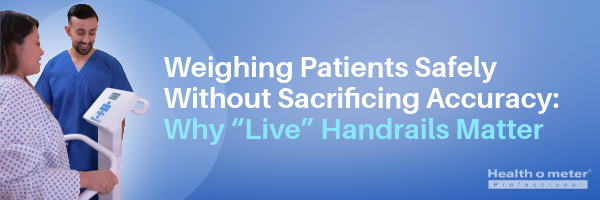
Accurate patient weight is more than a number—it’s a vital sign that influences clinical decisions every day. From medication dosing and fluid management to chronic disease monitoring, small inaccuracies can have outsized downstream effects. At the same time, many patients need additional support to safely step onto and stand on a scale.
Balancing patient safety and measurement accuracy is a challenge many physician clinics face. Unfortunately, some well-intentioned solutions may be doing more harm than good.
The Challenge: Patient Stability During Weighing
Patients with mobility limitations, balance issues, advanced age, or post-surgical needs often require something to hold onto while being weighed. Clinics want to reduce fall risk and provide reassurance—and rightly so.
To address this, it’s common to see:
- Wall-mounted grab bars installed near a scale
- A walker positioned around a scale platform
While these approaches appear to improve safety, they introduce a less obvious—but clinically significant—problem.
The Hidden Issue with Wall-Mounted Handlebars and Walkers
When a patient touches anything that is not mechanically connected to the scale, some portion of their body weight is transferred off the scale.
That means:
- The recorded weight is inaccurate - lower or higher than the patient’s true weight
- Readings may vary depending on how much support the patient uses
- Weight trends over time become unreliable
Even light contact—resting a hand on a handrail or leaning slightly on a walker—can alter the measurement. Because this offloading is inconsistent from one visit to the next, it introduces variability that is difficult to detect and impossible to correct after the fact.
In short, the scale may appear to function properly, but the data it produces cannot be trusted.
Why Accuracy Matters More Than Ever
Weight is often treated as routine, but its impact is anything but:
- Medication dosing may rely on accurate body weight
- Chronic conditions such as heart failure or renal disease depend on consistent weight trending
- Inaccurate data can lead to inappropriate clinical decisions
- Inconsistency undermines confidence in patient records
When clinics rely on workarounds that compromise accuracy, they unintentionally trade patient safety in one area for clinical risk in another.
The Right Solution: Scales with “Live” Handrails
Patient scales designed with integrated, load-bearing (“live”) handrails eliminate this trade-off.
Unlike wall-mounted bars or external walkers:
- Live handrails are mechanically connected to the scale
- Any force applied to the handrails is fully captured by the scale’s load cells
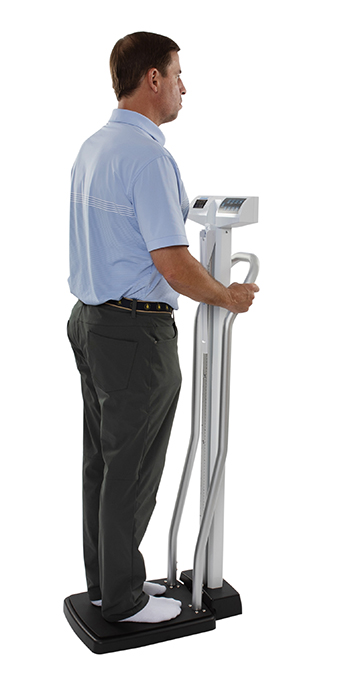
- Patients receive the support they need without removing weight from the measurement
This design allows patients to stabilize themselves naturally, while ensuring that 100% of their weight is measured accurately.
Benefits for Patients and Clinics
Patient scales with live handrails offer a clear advantage:
- Improved patient confidence and safety during weighing
- Accurate, repeatable weight measurements
- Reduced variability between visits
- Elimination of improvised, non-standard solutions
- Better clinical decision-making supported by reliable data
Most importantly, clinics no longer have to choose between fall prevention and measurement integrity.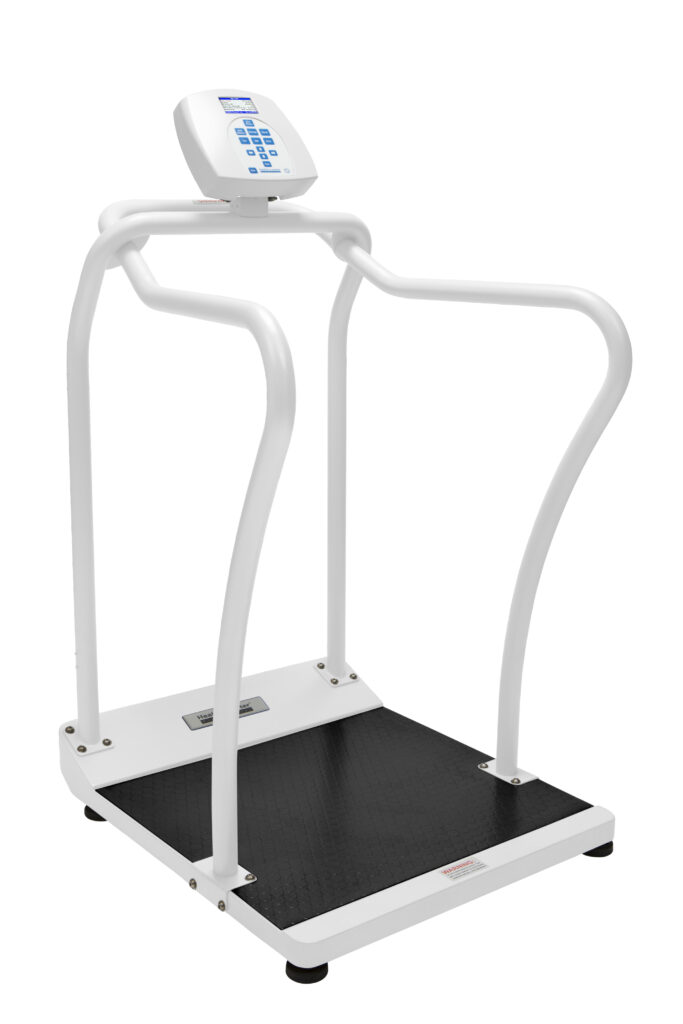
A Better Standard for Patient Weighing
The use of wall-mounted grab bars or walkers around scales is a common and understandable response to a real clinical need. However, these solutions introduce measurement error at the very moment accuracy matters most.
As clinics evaluate their weighing environments, it’s worth asking a simple question:
Is the support system helping the patient—or compromising the data?
Patient scales with live handrails provide a safer, more accurate, and more clinically sound approach—one that aligns patient care, workflow efficiency, and data integrity.
At Pelstar, we design patient scales that prioritize both safety and accuracy. Learn more about our solutions at homscales.com or contact us to find the right fit for your facility.