
 Safe Patient Handling
  Gold Rollboards
With ADA Medical Diagnostic Equipment (MDE) compliance deadlines approaching, more healthcare facilities are taking a closer look at whether their equipment truly supports accessible, equitable care. Weight measurement is a basic part of nearly every clinical visit—but for patients who use wheelchairs or have limited mobility, it can quickly become stressful or unsafe without the right equipment in place. 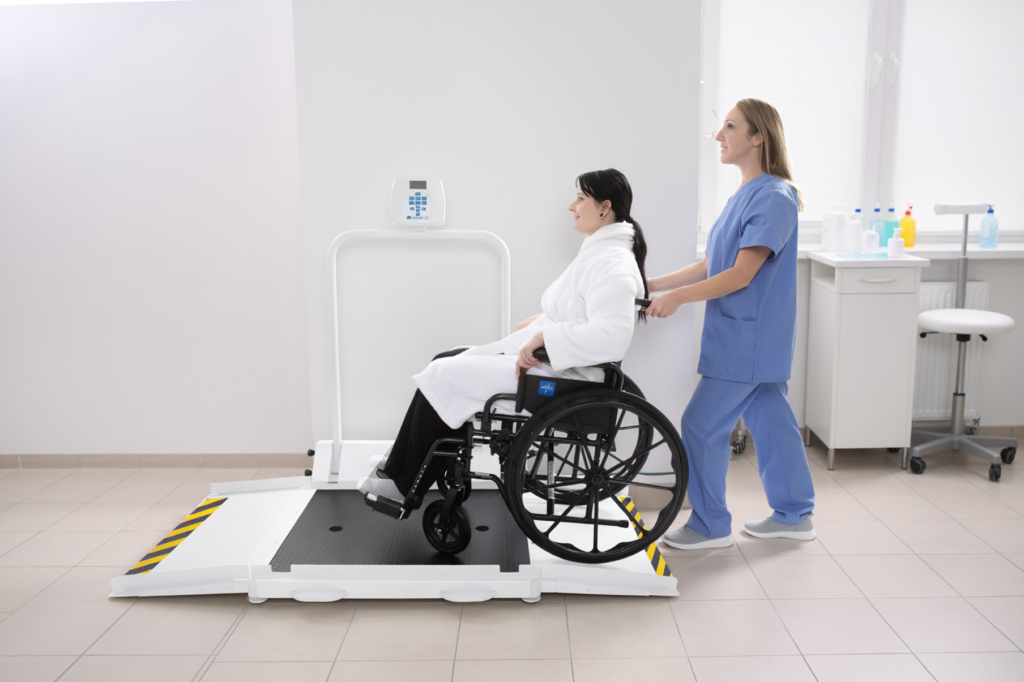
An ADA Compliant wheelchair scale helps facilities weigh every patient safely, accurately, and respectfully. It also improves staff safety, workflow efficiency, and regulatory preparedness. If you’re already planning to invest in one, you’re taking an important step toward more inclusive care. Before you purchase, here are five things to consider to make sure you choose the right scale for your facility.
ADA wheelchair scales must accommodate mobility devices safely, which means they require enough clearance and platform space for access and maneuverability.
As a general guideline:
- Minimum platform width: typically 36 inches (or 32 inches if the platform height is under 4")
- Minimum platform depth: typically around 40 inches
While ADA standards require a minimum space of 36" x 40", many wheelchair scales have a larger footprint—often closer to 77" wide x 45" deep—to allow for ramps, stability, and safe entry and exit. That’s roughly the size of a small dining table or a large office desk.
Facilities should also plan for clear floor space and turning space so patients using wheelchairs, scooters, or walkers can approach and exit without obstruction.
Pro tip: If space is limited, consider a wall-mounted fold-down wheelchair scale. It can provide accessibility without permanently taking up valuable floor space.

Not all scales marketed as “ADA-friendly” are actually compliant. One of the most important factors to look for is independent, third-party certification.
A certified ADA-compliant scale means:
- Independently verified compliance with ADA and MDE accessibility standards
- Reduced legal risk, helping protect facilities from discrimination claims
- Greater regulatory confidence, especially during inspections or audits
Certified compliance doesn’t just support patients—it helps reduce exposure to costly legal or regulatory challenges that may result from unverified claims.

ADA requirements can be complex—and they continue to evolve. That’s why it’s important to work with a manufacturer that specializes in ADA compliance, not one simply labeling products as accessible.
An ADA-focused manufacturer can help:
- Interpret applicable ADA and MDE requirements
- Evaluate your facility’s layout and workflow needs
- Recommend the right scale type, capacity, and configuration
- Provide documentation that supports compliance efforts
Expert guidance can save time, reduce confusion, and prevent costly mistakes—both now and in the future.

Many patients who need wheelchair-accessible weighing may also require higher-capacity equipment. Your scale should support the appropriate weight range while maintaining clinical-grade accuracy.
Key performance features to prioritize include:
- High weight capacity, including for bariatric patients
- Wheelchair tare functionality, to subtract wheelchair weight for accurate readings
- Stable, non-slip platforms, to improve patient safety
Accurate weights matter for medication dosing, dialysis, oncology care, cardiac treatment planning, and more. The right scale supports better outcomes—not just better compliance.

A wheelchair scale should integrate smoothly into your existing processes—not disrupt them. The goal is to make weighing simple, consistent, and repeatable across departments and shifts.
A good ADA-compliant wheelchair scale should:
- Allow patients to be weighed where they already are, reducing unnecessary movement
- Support quick weigh-ins with minimal setup
- Standardize the weighing process across staff
- Reduce bottlenecks during intake, triage, or rooming
When weighing becomes easier for staff, patients receive faster, more dignified care—and facilities benefit from improved consistency and efficiency.
Final Thoughts
With ADA/MDE compliance expectations already in effect and key milestones approaching, now is the time to make sure your facility is prepared. Investing in an ADA-compliant wheelchair scale reinforces your commitment to inclusive care, patient dignity, staff safety, and regulatory responsibility.
By considering space requirements, third-party certification, manufacturer expertise, performance features, and workflow fit, you can choose a solution that meets today’s needs—and supports tomorrow’s expectations.
A Note About Health o meter® Professional Scales
As accessibility expectations rise, simply claiming “ADA compliant” is no longer enough. Certified ADA compliance is the difference. Health o meter® Professional was the first manufacturer to design medical scales aligned with ADA standards and the first to have those designs independently certified. Today, Health o meter® Professional remains the only manufacturer offering a full portfolio of Certified ADA Compliant scales, supported by documentation facilities can rely on during inspections, audits, and accreditation reviews.
Learn more about Health o meter Professional's ADA product line visit /ada-mde/